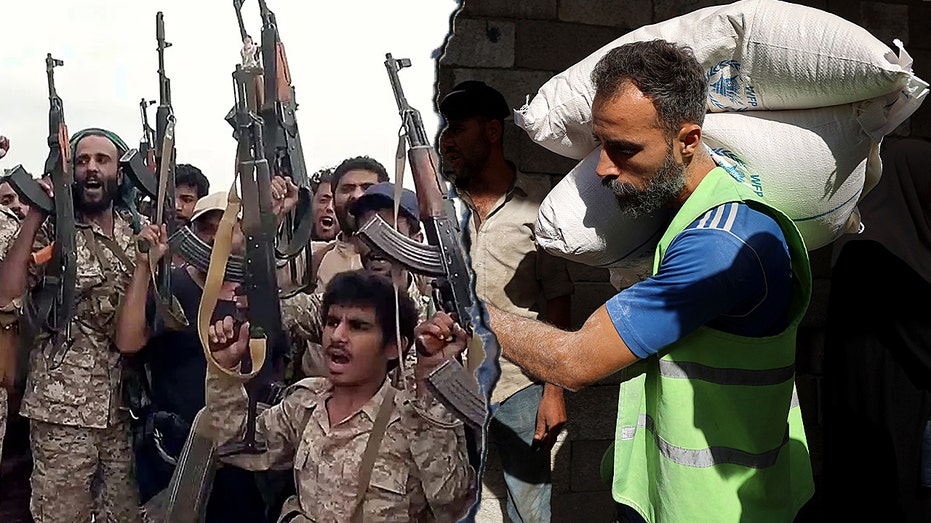
Thirty-seven United Nations World Food Programme (WFP) workers are being held captive by Iran-backed Houthi terrorists in Yemen, the agency’s new executive director told Fox News Digital on Wednesday. Many have been detained for two years.
Luke J. Lindberg’s remarks come as WFP workers face growing threats in some of the world’s most dangerous conflict zones, where hundreds have died risking their lives to save others, he said.
“Right now in Yemen, we have 37 colleagues of ours who are currently detained,” Lindberg said.
IRAN-BACKED TERROR PROXY HOUTHIS THREATEN FRESH ATTACKS AFTER YEMEN AIRPORT STRIKE
“These folks are out there to provide basic humanitarian services. They’re not there to influence the political outcomes of a conflict. And so we need to protect them, and we need to get our detained colleagues released.”
“All detainees are Yemeni nationals employed locally by the WFP, Lindberg clarified, before stating that some have been separated from their families for “nearly two years,” he clarified.
“It’s a really complex political environment,” Lindberg continued before adding that there are no current Americans in that pool.
“They are all locally employed Yemenis,” he clarified.
Just three days into his tenure, Lindberg raised the detentions with U.S. Ambassador to the United Nations Mike Waltz, underscoring the urgency of securing the workers’ release.
“Ambassador Waltz is aware, and the State Department team has done a great job of taking this seriously and also, it’s a priority for them as it is for us to get these folks released.”
TRUMP OFFICIALS UNVEIL PRIVATE SECTOR BLUEPRINT FOR LIFE AFTER USAID
“It’s been almost two years,” Lindberg said. “Away from their families. It breaks my heart.”
The detentions come amid Yemen’s crippling civil war between the internationally recognized government and Iran-backed Houthis, which has devastated the economy and left millions dependent on humanitarian aid.
More than 18 million people face acute food insecurity, including more than two million children under age five suffering from acute malnutrition.
“Our team operates in the most impossible and challenging conditions you can imagine around the world,” Lindberg said.
“People like me, we’re not out in the field, literally handing food to people and literally cooking food for people so that they get the nourishment. It’s the wonderful people, the people that choose to go out and do this work that are the real heroes of this equation.”
Lindberg said the WFP must now balance reaching vulnerable populations with protecting employees from unacceptable risks.
“And so there are areas where we will go into, areas where you can’t go into. Again, the goal is the end of the conflict and allow humanitarian resources to flow into those areas.
“And until that happens, there are areas where we do not operate so that our staff can remain protected and that they can do their job safely.”
US VISA CLASH EXPOSES SUDAN’S FORGOTTEN WAR AS FOREIGN POWERS COMPETE FOR STRATEGIC FOOTHOLD
The dangers extend beyond Yemen, with Lindberg saying conflict drives roughly two-thirds of acute food insecurity worldwide, with an estimated 266 million people facing severe hunger.
“It means the most challenging levels of hunger we can imagine,” Lindberg said.
The crisis has intensified pressure on humanitarian organizations to deliver food in some of the world’s most dangerous and inaccessible regions.
“But the World Food Programme really has a great team operating in over 120 countries around the world, doing this hard work each and every day,” he explained.
Among the most urgent crises, he said, are those in Sudan, South Sudan and Somalia, where conflict, displacement and climate-related disasters have pushed vulnerable communities toward famine.
Fighting between the Sudanese Armed Forces and the Rapid Support Forces has displaced millions and triggered famine conditions in parts of the country, with Lindberg saying Sudan will be his first field destination as executive director, reflecting the urgency of the crisis.
“Right now, we are approaching famine levels in three countries, predominantly in the Africa region, in Sudan, South Sudan and Somalia,” he said.
“And so those are flash points for me that are incredibly important for us to focus on, find the resources that should be available to help us meet those needs specifically.”
Other humanitarian emergencies include Gaza, where fighting, damaged infrastructure, restricted access and funding shortages have complicated food deliveries, and Haiti, where gang violence has disrupted aid access.
SAUDI ARABIA ON EDGE: ICONIC KINGDOM CENTRE SENDS WORKERS HOME AMID HOUTHI ATTACKS
In the Democratic Republic of the Congo, fighting involving armed groups has displaced millions, while the war in Ukraine has also disrupted agricultural production and global food supply chains.
But Lindberg said one of the most disturbing consequences of these conflicts is the rising death toll among humanitarian workers with hundreds killed worldwide in recent years.
“Unfortunately, in the past couple of years, we’ve lost over 700 humanitarians around the world in their active duty.
“To me, that’s the worst possible outcome. It’s really unacceptable. And so yes, many of our World Food Programme colleagues have unfortunately been caught up in those circumstances as well.
“It’s my commitment to call each one of those family members should that happen, but it’s primarily my goal to not let that happen anymore.”
Lindberg’s appointment comes as the WFP confronts major humanitarian emergencies and funding pressures, while also bringing the agency a direct connection to President Donald Trump.
A South Dakota native, Lindberg previously served as undersecretary of agriculture for trade and foreign agricultural affairs at the U.S. Department of Agriculture, overseeing international agricultural assistance programs, including the McGovern-Dole Food for Education and Food for Progress programs.
Lindberg succeeds Cindy McCain, who stepped down this year, with Deputy Executive Director Carl Skau serving in the interim. Since 1992, six executive directors were American.
SAUDI FOREIGN MINISTER WARNS HOUTHI THREAT GOES GLOBAL AS TRUMP HOLDS FIRE
U.N. Secretary-General António Guterres and Food and Agriculture Organization Director-General Qu Dongyu appointed Lindberg after consulting the WFP Executive Board.
Lindberg said Trump personally called to ask him to serve as the U.S. nominee for the position, a conversation he described as evidence of the president’s commitment to humanitarian efforts.
“When I was nominated to lead the World Food Program by the United States, President Trump personally took the time to call me and offer me this opportunity,” Lindberg said.
“And to me, that shows his heart for this work. He is somebody that believes in peace around the world. And for me to have the opportunity to speak with him about how the World Food Programme can.
“To play an important role alongside the U.S. in addressing these humanitarian needs was a special moment that I’ll never forget.”
That said, Lindberg is adamant that his new job at the World Food Programme comes with a clear mission: “show up no matter what.”
That means focusing on delivering food to those who need it, regardless of the politics involved.
“To safely and effectively deliver food, and to really stay out of the politics of it, our goal is to feed hungry people.”
Fox News Digital’s Sydney Finver contributed to this report.