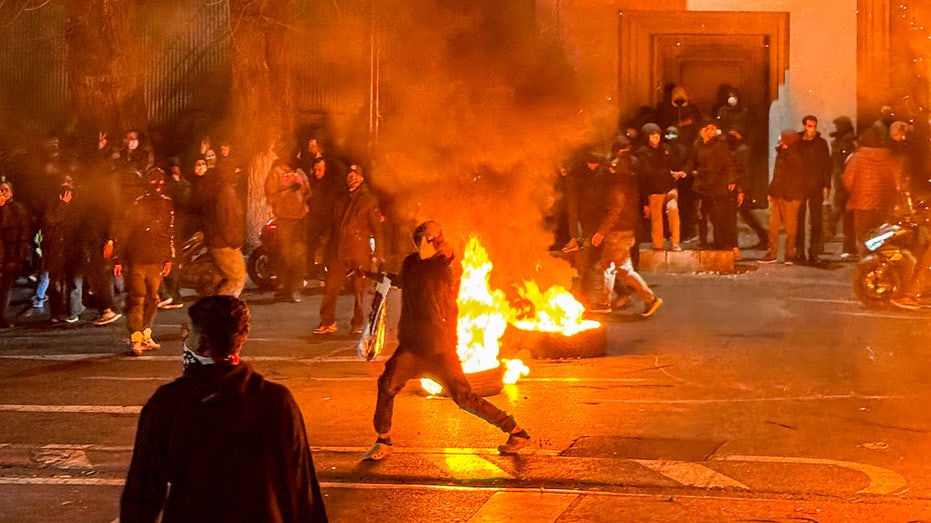
Iran is set to execute its first female protester tied to the January 2026 uprising in Tehran, according to multiple human rights organizations.
Bita Hemmati was named in a collective death sentencing alongside three other defendants, including her husband, Mohammadreza Majid-Asl, 34, according to the National Council of Resistance of Iran (NCRI) and the Human Rights Activists News Agency (HRANA).
The couple’s reported neighbors, Behrouz Zamaninejad and Kourosh Zamaninejad, were also sentenced to death, while a relative, Amir Hemmati, received five years in prison.
The verdicts mark some of the most recent capital punishment decisions amid the government’s broader crackdown on suppressing unrest. Possibly thousands of protesters have reportedly been killed since demonstrations erupted this year.
TRUMP DETAILS SWEEPING ‘ALL OR NOTHING’ BLOCKADE OF STRAIT OF HORMUZ AFTER FAILED IRAN TALKS
“Mohammadreza Majidi-Asl and Bita Hemmati are a couple living in Tehran, and Amir Hemmati is a relative of the two,” a source told HRANA. “Kourosh Zamaninejad and Behrouz Zamaninejad were living in the same residential building, and their arrests took place simultaneously.”
No execution date has yet been given.
The Tehran Revolutionary Court reportedly accused the defendants of multiple offenses, including national security disruption in connection with the “hostile government of the United States,” according to HRANA.
On Jan. 8 and 9, the defendants allegedly used explosives and weapons, threw objects such as concrete blocks and incendiary materials from rooftops, injured security forces, and engaged in “propaganda against the regime” in an effort to undermine security, according to federal authorities.
IRAN THREATENS TO HALT RED SEA TRAFFIC IN RESPONSE TO US MILITARY BLOCKADE OF PORTS
Alongside the capital punishment verdicts, the court also issued five years of discretionary imprisonment and ordered the seizure of their personal assets.
Officials added that the fifth associate, Amir Hemmati, was specifically convicted of “assembly and collusion against national security” and “propaganda against the regime,” the groups said.
Human rights activists further raised concerns that the defendants’ confessions may have been coerced, citing allegations of torture and interrogation.
The organizations, which are urging a halt to the executions, also claimed a lack of specific evidence linking the accused to the alleged crimes, and argued that Tehran is seeking to intimidate the public in order to prevent future civilian unrest.
Widespread protests first erupted in late December 2025 in Tehran amid an economic crisis marked by a collapsing currency and soaring inflation. Tensions then quickly escalated into broader anti-government unrest that spread across multiple cities.
Washington officially joined the conflict with the launch of Operation Epic Fury on Feb. 28, 2026, when it conducted massive joint airstrikes with Israel that killed Supreme Leader Ali Khamenei.